
Go / No-Go
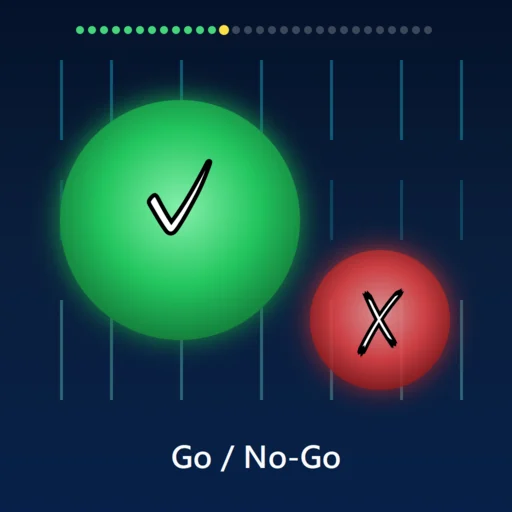
Tap on GREEN. Do NOT tap on RED. 30 trials of pure impulse control.
More games
See all →









About the Go / No-Go test
The Go/No-Go paradigm is one of the most-studied tasks in cognitive neuroscience. Two signals appear at random — a "Go" stimulus that you must respond to as quickly as possible, and a "No-Go" stimulus that you must hold yourself back from responding to. Sounds easy until you try it: when 70% of trials are Go, your finger naturally builds up a habit of tapping, and the red No-Go feels almost impossible to ignore.
In Kioku Games we run 30 trials with the standard 70:30 Go-to-NoGo ratio. Each Go you correctly tap is +50, each NoGo you correctly hold is +30, but a missed Go is -25 and — most painfully — a slip on a NoGo costs -100. Streaks of 5 / 10 / 15 in a row trigger gold, rainbow, and platinum bonus flashes.
Why it is hard
The brain region most responsible for stopping an already-prepared movement is the right inferior frontal cortex. Functional MRI studies consistently show this region lighting up just before a successful No-Go inhibition. People with ADHD, certain anxiety disorders, and acute sleep loss show measurable drops in their No-Go accuracy — which is why this test ended up in clinical research in the first place.
You can watch your own performance degrade in real time as the run goes on: the first ten trials feel almost trivial, by trial twenty the rhythm of the Go signal has hijacked your motor cortex, and the last few NoGos demand genuine willpower. That last-minute "I almost tapped!" feeling is exactly the inhibitory control the task measures.